Tuesday, 22 November 2011


Sunday, 20 November 2011
Mild, General Learning disabilities
Guideline for Teachers of Students with mild General Learning Diasbilities
Excellent document for studnets with mild learning differences in Art, Craft and Design
http://www.ncca.ie/uploadedfiles/PP_Art.pdf
Scheme of work Textiles
Draft scheme of work Textiles

https://docs.google.com/document/pub?id=15FGsh6mQpt2Avmm5EdhZnxsLSskB1_4jO9ES3v-QWrg

https://docs.google.com/document/pub?id=15FGsh6mQpt2Avmm5EdhZnxsLSskB1_4jO9ES3v-QWrg
Saturday, 19 November 2011
Textiles
Exploring my ideas
I did think of using this idea but focussing on one or two plants to create a map but with other ideas flooding in about the fauna as well as the flora moved me on to looking at ways of simplifying my illustrations and including more, not less flora and fauna. I collated images of:
Creating the canvas map:
I drew the images on to paper and then transferred the images by placing the silk over the drawing and tracing through the material.


Colour


 1. Draw the design on Paper
 2. Transferring the design on to silk.make a wooden frame to attach the material to.
 3. Using wax resist to create a design on silk by following the drawn lines or filling in the back ground
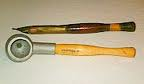 4. Using Batik tools and paint brushes, different Batik tools create different effects on the silk depnding on how large the hole is that lets the wax run. Paint brushes can be used in different ways depending on the size and shape. I used very small paint brushes to give detail to the work.
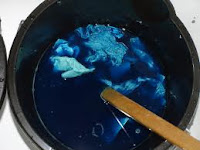 5. Dyeing the silk - I followed the instructions on the dye packet and left the silk in the buket for 30 minutes to make sure I had a strong black colour.
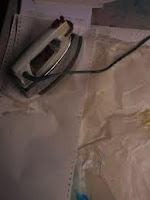 6. Ironing the silk to remove the wax - it took lots of news print paper to remove all the wax from the silk.

On Reflection
I wanted to find new ways of documenting and cataloguing my garden, originally when I conceived the idea I was going to document each plant I found in four different ways-
· Photograph
· Drawn Illustration of the plant in situ
· Dry and press the plant using a flower press or a homemade press for larger plants
· Write about the plant using reference books (the plants chemical compounds, uses in herbalism and modern medicine, other uses the plant has e.g. nettles used in the first world war by the German’s to make uniforms)
And produce a book of the work; this is a very conventional way of documenting flora and fauna and I wanted to move away from convention and create a design that incorporated shape, line, and form.
In addition, this level of documentation is time consuming and requires a level of dedication (possibly one for retirement or the summer holidays only!).
Animal footprints
Silhouettes of butterflies, moths, lizard, flowers
Map of Derainey
Illustrations of honey suckle, iris’s, nettles, bind weed etc.. I had done over the last couple of years as well as photographs I have of the moths that have been documented in Derainey by an Irish moth specialist.
I started to create a map using the animal footprints on one side and a map of Derainey on the other
I stiffened the canvas with fabric stiffener, cut out stencils of animal tracks, and used black acrylic paint to create the image. This was not working well but because I had stiffened the fabric, it made it almost impossible to embroider or sew on beads etc.. I also felt it was a little contrived and not as spontaneous and as I wanted. Even though I had spent time on construction of the map, images to go on the map the design was lacking in line, form, and shape.
 |
| Embroidery Running stitch on canvas map |
 |
| Stenciled animal foot prints on canvas map |
Creating the design on silk
To create more line and shape I constructed a grid using the map folds idea, I produced a grid containing 16 oblong boxes with space between the boxes representing picture frames.

To express the delicate and fragile nature of the flora and fauna I used silk. The properties of silk: natural product, delicate, strong but can be easily ripped or torn, soft to the touch, and woven to make a very fine material, it can be folded and placed in your pocket.

I decided to use only one colour, black on the batik with a hint of red and green by using fabric paints. I was inspired by other black and white batiks I saw on the internet.


Step by step guide to producing a Batik design of Flora and Fauna on silk
1. Draw the design on Paper 2. Transferring the design on to silk.make a wooden frame to attach the material to.3. Using wax resist to create a design on silk by following the drawn lines or filling in the back ground4. Using Batik tools and paint brushes, different Batik tools create different effects on the silk depnding on how large the hole is that lets the wax run. Paint brushes can be used in different ways depending on the size and shape. I used very small paint brushes to give detail to the work.
 5. Dyeing the silk - I followed the instructions on the dye packet and left the silk in the buket for 30 minutes to make sure I had a strong black colour.
 6. Ironing the silk to remove the wax - it took lots of news print paper to remove all the wax from the silk.
7. Finished Batik

I should have spent more time on my design, I found it very easy to go off on a tangent and look at human geography, maps of the world, ancient maps, typography of 1910 – 1920, think about photograph albums, portraiture, map folds, map typography….. the list goes on, instead on focussing on my design. Although I do feel, I have a number of scheme ideas from this one project especially around fabric printing and mapping.
Wednesday, 2 November 2011
Textile Project research
Textiles project
Ideas based on previous work
 |
| View from my house overlooking bog land at the bottom of my land |
Brief
Using textiles as a medium create an artwork based on the flora and fauna of Derainey.
My Ideas
1. Create a map of Derainey using silkscreen printing and possible over lays using acetate
2. Use symbols or silhouettes to show various flora and fauna of Derainey, printed using stencils on to fabric
3. Use canvas and print on both sides of material to create a map, folded as a traditional map
4. Depict the images of flora and fauna as if they are in an old photographic album
5. Produce a batik based on images created for mapping
Mapping my Garden
Research for textile project
Maps:
Ordinance survey map of East Clare, Walking maps of East Clare, Lettering styles of old maps, Old maps, Map Legends, signs and symbols, Map folds
 |
| Walking map of East Clare |
 |
| Map folds |
 |
| Map folds |

Map symbols / legend

Photograph albums:


Lettering used on old photographic albums

Fox, Badger, Rat, Fallow deer, Cat, Dog, Heron, Crow


Materials:
Canvas, hessian, coloured canvas
Stencils
Black acrylic paint
Embroidery thread
Watercolour pencils
Fabric pens
Silk
Batik tools
Dylon dies
Paintbrushes
Needle
Sponge
Silk screen frame


Tuesday, 1 November 2011
Creativity in Education – what does this mean?
“The roots of a creative society are in basic education. The sheer volume of facts to be digested by the students of today leaves little time for a deeper interrogation of their moral worth. The result has been a generation of technicians rather than visionaries, each one taking a career rather than an idea seriously. The answer must be reform in our educational methods so that students are encouraged to ask about “know-why” as well as “know-how”. Once the arts are restored to a more central role in educational institutions, there could be a tremendous unleashing of creative energy in other disciplines too.”
Source: On Arts: Creative New Zealand. Michael D. Higgins, the former Irish Minister for Arts, Culture and Gaeltacht
“All our futures: Creativity, culture and education”, the UK National Advisory Committees report [DfEE, 1999] defines creativity as:
“First, they [the characteristics of creativity] always involve thinking or behaving imaginatively. Second, overall this imaginative activity is purposeful: that is, it is directed to achieving an objective. Third, these processes must generate something original. Fourth, the outcome must be of value in relation to the objective.”
The following quote, from one of the teachers involved in the project, adds to the UK definition.
“Although most people might look for signs of creativity in the appearance of the bulletin boards, student made projects, centres and displays in the classroom, I feel the truly creative classroom goes way beyond what can be seen with the eyes. It is a place where bodies and minds actively pursue new knowledge. Having a creative classroom means that the teacher takes risks on a daily basis and encourages his/her students to do the same.”
Why should we bother?
• Our school system is a thinly disguised conspiracy to quash creativity.
The above from Tom Peter’s book Re-imagine. Peter’s is very critical of our present ways of educating and although focused on American education his comments could relate to most education systems across the world.
Is this a vision that you could buy into?
Robert Fritz comments that “The most important developments in civilization have come through the creative process, but ironically, most people have not been taught to be creative.”
Is it important to our futures that creativity be taught?
“By providing rich and varied contexts for pupils to acquire, develop and apply a broad range of knowledge, understanding and skills, the curriculum should enable pupils to think creatively and critically, to solve problems and to make a difference for the better. It should give them the opportunity to become creative, innovative, enterprising, and capable of leadership to equip them for their future lives as workers and citizens. It should enable pupils to respond positively to opportunities, challenges, and responsibilities, to manage risk and cope with change and adversity.”
Source: On Arts: Creative New Zealand. Michael D. Higgins, the former Irish Minister for Arts, Culture and Gaeltacht
Source: Pann Baltz quoted in Creativity in the Classroom: An exploration.
• We are at an inflection point. We seem to be re-inventing everything – except the school system, which should [in theory] underpin, even leads, the rest.
• The main crisis in schools today is irrelevance.
• Our educational thinking is concerned with; ‘what is’. It is not good at designing ‘what can be’.
Peter’s vision:
- a school system that recognizes that learning is natural, that a love of learning is normal, and that real learning is passionate learning - a school curriculum that values questions above answers, creativity above fact regurgitation, individuality above uniformity and excellence above standardized performance - a society that respects its teachers and principals, pays them well, and grants them the autonomy to do their job as the creative individuals they are, and for the creative individuals in their charge.
Source: Robert Fritz, The Path of Least Resistance, 1994.
What place should creativity have in our education systems?
Should we teach creatively or teach for creativity?
Source: UK National Curriculum Handbook [p 11-12]:
Creative students lead richer lives and, in the longer term, make a valuable contribution to society. Surely those are reasons enough to bother.
Subscribe to:
Posts (Atom)